


Your cloud may be modern. Your architecture may not be ready for AI.
Cloud modernisation used to be about moving applications, infrastructure and data into a better operating environment. The question has changed.
Can the environment you have today support the applications, data flows, integrations, security controls and operating model required by what you want to build next?
The question worth asking before the next AI pilot What would prevent this use case from becoming a secure, reliable production capability inside your existing technology environment?
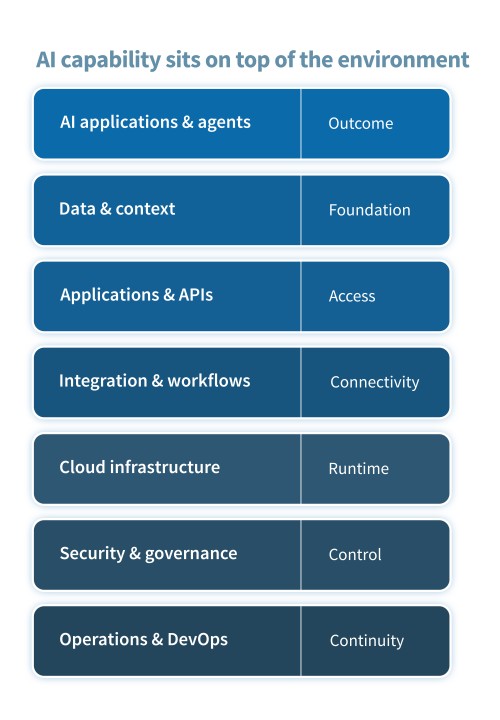
The shift
Cloud migration was the first chapter. AI-ready transformation is the next.
Many organisations have already moved workloads to the cloud. That does not automatically make those workloads ready for AI.
AI workloads introduce new demands around scalable compute, governed data access, integration, observability, security, deployment and operational control.
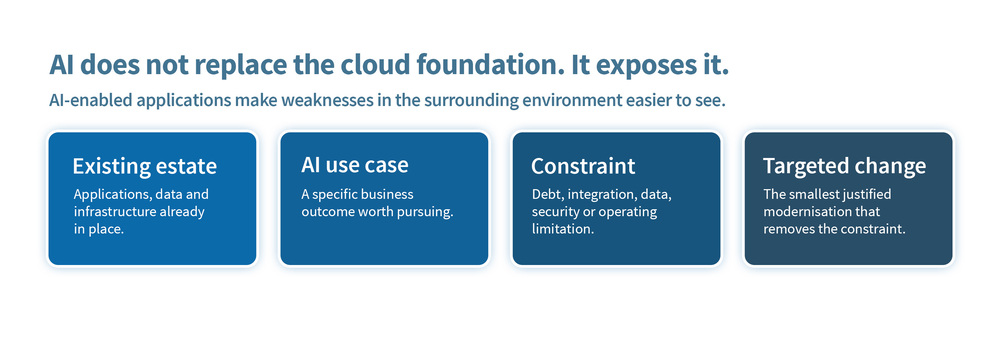
The practical implication is important. You do not necessarily need to rebuild everything. You need to understand where the existing environment creates constraints and modernise where those constraints actually matter.
Research signal
AWS enterprise guidance and Microsoft's Cloud Adoption Framework both treat production AI adoption as an architecture, security, governance, readiness and operations problem rather than simply a model-selection exercise.
The Assessment Model
Six foundations determine whether cloud can support what comes next.
AI readiness is not a badge you earn by choosing a model or moving a workload to a cloud provider. It is a property of the surrounding technology environment.
01. Applications: Can existing applications change, expose useful capabilities and participate in new workflows without creating excessive risk?
02. Data: Is the required data discoverable, trusted, governed, contextualised and securely accessible?
03. Integration: Can AI-enabled applications interact with the systems that actually run the business?
04. Cloud Infrastructure: Can the environment provide appropriate compute, storage, networking, resilience and cost control?
05. Security & Governance: Are identity, permissions, sensitive data flows, auditability and AI-specific risks understood?
06. Operations: Can the capability be deployed, monitored, supported, scaled and changed safely after the pilot ends?
01 · APPLICATION READINESS
Modernise the application only where it changes the outcome.
Legacy does not automatically mean unusable. A stable application can remain valuable for years.
The problem appears when its architecture prevents the organisation from introducing capabilities that matter.
02 · TECHNICAL DEBT
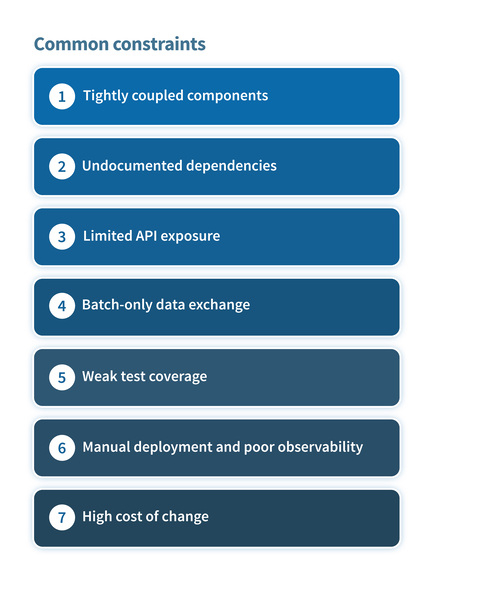
Technical debt becomes strategic when it starts blocking change.
The maintenance cost of an old system is only part of the story. The more consequential question is what that system prevents the organisation from building, integrating, automating or changing.
-
APPLICATION (Code & dependencies): Unsupported frameworks, brittle modules, weak testing and difficult-to-change components.
-
ARCHITECTURE (Structure & coupling): Tight dependencies, unclear boundaries and large blast radius for seemingly small changes.
-
DATA (Fragmentation): Duplicated data, unclear ownership, inconsistent definitions and limited accessibility.
-
INTEGRATION (Connectivity): Point-to-point interfaces, manual hand-offs and brittle synchronisation patterns.
-
SECURITY (Control debt): Legacy identity patterns, weak auditability and unsupported security components.
-
OPERATIONS (Delivery friction): Manual deployments, weak observability and excessive operational dependency on individuals.
The AI-readiness question Do not ask: "Is this application modern?" Ask: "Can this application participate in the future architecture required by our priority AI use cases?"
03 · DATA READINESS
AI cannot compensate for data the organisation cannot trust.
Enterprise data rarely lives in one clean system. It can sit across CRM, ERP, operational databases, documents, SaaS platforms and legacy applications.
The cloud architecture therefore needs to answer more than "Where do we store the data?"
It needs to answer whether the right systems can access, interpret and govern it for the intended use case.
1. Inventory: Do we know where important data resides?
2. Ownership: Who is accountable for important datasets?
3. Quality: Is it accurate, complete and consistent enough?
4. Context: Can the AI system understand its business meaning?
5. Access: Can authorised systems retrieve it securely?
6. Governance: Are privacy, retention and audit requirements defined?
04 · INTEGRATION
AI meets the enterprise at the integration layer.
Many AI use cases are not standalone applications. They sit inside an existing workflow.
An assistant may need customer information from a CRM, transaction data from an ERP, documents from a repository and operational information from another application.
That makes integration architecture part of AI readiness, not an implementation detail to solve later.
-
APIs: Can systems expose what AI needs? Review API availability, documentation, authentication, rate limits and auditability.
-
WORKFLOWS: Can AI participate in the process? Identify where AI needs to retrieve information, recommend action or trigger downstream work.
-
DEPENDENCIES: What happens when something fails? Map failure paths, retries, fallbacks and human intervention.
05 · CLOUD ARCHITECTURE
AI changes what "good cloud architecture" needs to account for.
AI workloads can introduce different compute patterns, data movement, storage requirements, model dependencies and operational considerations.
The goal is not to adopt every new cloud service. The goal is to design an environment that supports the required workload without creating uncontrolled complexity or cost.
-
COMPUTE: Right-size the workload (Understand performance, concurrency, accelerator and scaling requirements before production).
-
NETWORK: Control data movement (Review connectivity, latency, private access and sensitive data flows).
-
COST: Model the economics (Estimate workload costs before usage patterns become difficult to control).
-
RESILIENCE: Design for failure (Consider availability, recovery, fallback behaviour and workload dependencies).
-
OBSERVABILITY: See what is happening (Monitor performance, errors, infrastructure and workload behaviour).
-
DEPLOYMENT: Make change repeatable (Establish controlled deployment and rollback paths before scaling the workload).
06 · SECURITY & GOVERNANCE
AI introduces new data and permission questions.
A cloud environment that was adequate for conventional applications may need additional controls when AI systems can retrieve, summarise, generate or act on enterprise data.
Security therefore needs to be considered as part of the architecture rather than added after the AI capability exists.
-
Who can access the AI capability?
-
What data can it retrieve?
-
What actions can it initiate?
-
Where are sensitive data flows occurring?
-
What needs human approval?
-
Can activity be audited?
07 · OPERATIONS & DEVOPS
A successful AI pilot still fails if nobody can run it.
Production readiness begins where the demo ends.
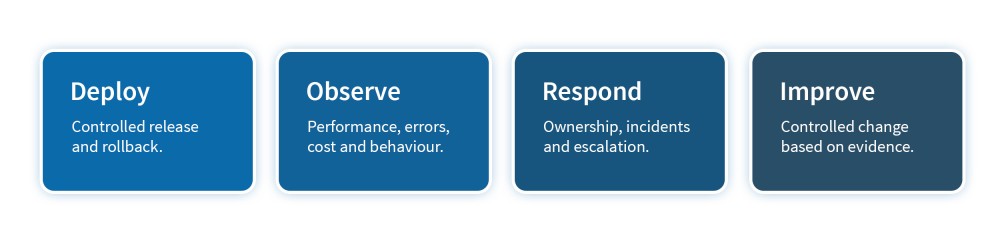
The environment needs clear ownership, deployment controls, observability, incident response, cost visibility and a way to evaluate whether the capability continues to perform as expected.
The modernisation decision
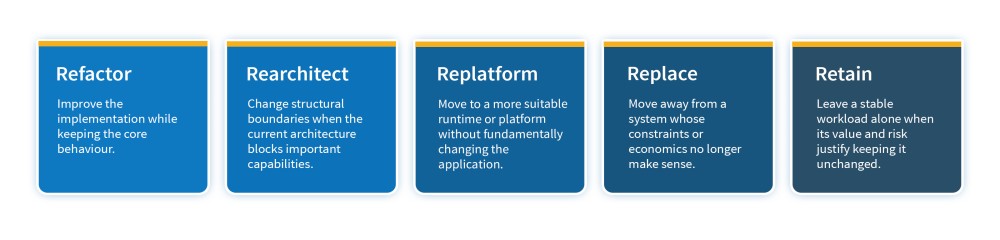
Modernisation is not synonymous with rebuilding.
Different workloads require different answers. The correct choice depends on business value, technical constraints, dependencies, risk and future relevance.
A useful discipline
Do not modernise a system because it is old. Modernise it because changing it, operating it, securing it or connecting it has become materially harder than the value of keeping it unchanged justifies.
AI-first lens
AI-ready Cloud Assessment
Start with evidence, not a migration proposal.
Before recommending a technology path, assess the environment against the use cases that actually matter.
01 · DISCOVER (Map the environment): Applications, infrastructure, data, integrations, ownership and critical workflows.
02 · ASSESS (Find the constraints): Technical debt, dependencies, security gaps, data limitations and operational friction.
03 · PRIORITIZE (Connect constraints to outcomes): Identify which changes materially affect business, AI and modernization priorities.
04 · DESIGN (Define the target state): Architecture, integration, security, infrastructure and operating requirements.
05 · PROVE (Test one meaningful slice): Validate the approach through a controlled modernization or AI-enabled workload.
06 · SCALE (Build the roadmap): Prioritized implementation, ownership, investment and measurable outcomes.
FROM ASSESSMENT TO ACTION
A practical 90-day path from uncertainty to evidence.
The objective is not to transform the entire estate in 90 days. It is to determine which changes actually matter and establish enough evidence to decide what should happen next.
DAYS 1–30 (Understand):
-
Priority AI and business use cases
-
Application and infrastructure map
-
Data and integration map
-
Initial technical-debt inventory
-
Risk assumptions
DAYS 31–60 (Prioritize):
-
Readiness scoring
-
Constraint prioritisation
-
Target architecture
-
Security and governance requirements
-
Modernisation backlog
DAYS 61–90 (Prove & plan):
-
Controlled modernization slice
-
AI-enabled production-oriented proof
-
Evidence from the implementation
-
Ownership and operating model
-
Scale roadmap
A BIX BYTES PERSPECTIVE
The right modernisation is usually smaller than the first proposal.
AI readiness is not the responsibility of a separate AI team alone. It can involve software engineering, cloud architecture, DevOps, security, data, integration, QA and operations.
That is why the starting point should be the existing environment and the business outcome, not a predetermined technology stack.
In practice, the useful intervention might be an application review, dependency analysis, API exposure, database modernization, infrastructure optimisation, observability improvement, security control or a targeted AI enhancement.
The objective is not to make everything new. It is to remove the constraints that prevent the organisation from moving forward.
EXECUTIVE CHECKLIST
Before you approve the next AI or cloud initiative.
-
Can we state the intended business outcome in one sentence?
-
Do we know which applications and data the use case depends on?
-
Have we assessed the existing architecture before selecting a target technology?
-
Do we know which technical debt actually matters?
-
Can the required systems exchange information without manual workarounds?
-
Are privacy, security and data-access requirements understood?
-
Can the workload be monitored once it reaches production?
-
Can the environment scale without uncontrolled cost?
-
Do we know what needs to be modernised and what can remain unchanged?
-
What evidence would justify scaling the initiative?
Frequently asked questions
Cloud modernisation, without the usual assumptions.
-
Does AI readiness mean rebuilding our existing applications?
No. AI readiness should begin with an assessment of the existing environment. Some applications may need targeted modernization, API exposure, improved observability or stronger identity controls. Others may be stable enough to retain.
-
What should be assessed before modernising for AI?
A practical assessment should consider applications, architecture, data, integration, cloud infrastructure, security and governance, and operations.
-
Can a modern cloud environment still be unprepared for AI?
Yes. A cloud environment can be technically modern while still having fragmented data, weak integration, limited observability, poor governance or application dependencies that constrain AI workloads.
-
Should every legacy application be modernised?
No. The appropriate decision may be to refactor, rearchitect, replatform, replace or retain a workload depending on business value, technical constraints, risk and future strategic relevance.
Start with the environment you already have
Before modernising everything, find out what actually needs to change.
Bix Bytes can help assess the existing cloud, application, data, integration and operational environment against the AI and business outcomes you are targeting.
Discuss an AI-ready Cloud Assessment
About the Author

Bix Bytes Solutions
About Bix Bytes Solutions
Bix Bytes Solutions is a technology engineering and consulting company with expertise in custom software development, cloud engineering, application modernization, and technology consulting. Our engineering teams work with businesses on the challenges that come with building, maintaining, and scaling software systems. This article reflects our practical perspective on managing technical debt and building technology that can evolve with business needs.
Research & references
Sources behind the framework
-
Microsoft, Cloud Adoption Framework.
-
Carnegie Mellon Software Engineering Institute, Technical-debt and architecture-focused measurement research.
-
Martin Fowler, Technical Debt.
Research sources provide external evidence and established frameworks. Bix Bytes material is used to describe Bix Bytes' own capability architecture and point of view.


GET IN TOUCH


SWITZERLAND
Bix Bytes Solutions Pvt. Ltd.
Zunstrasse 11
8152 Opfikon
Switzerland

INDIA - Mangalore
Bix Bytes Solutions Pvt. Ltd.
3-1-46, Bejai Main Rd
Mallikatte, Bejai
Mangaluru -575004
Karnataka, India.

CANADA
Bix Bytes Solutions
315 St Germain
Ave Toronto ON M5M 1W4 Toronto Ontario
Canada
INDIA - Bangalore
Bix Bytes Solutions Pvt. Ltd.
Brigade Rubix, 20, Unit No. 204, 2nd floor,
HMT Watch Factory Main Road,
Phase 1, Peenya, Bangalore 560 022
Karnataka, India.
Copyright © 2026 BixBytes Solutions