


The Hidden Cost of Technical Debt: How Legacy Systems Impact Business Growth
Aug 19, 2026


Technical debt can increase maintenance costs, slow innovation, reduce developer productivity, increase operational risk, and make software modernization more difficult. Here's how to identify, prioritize, and reduce it.
What Is Technical Debt?
Technical debt is the future cost and complexity created when software teams choose a faster or easier technical solution instead of a more sustainable one.
While technical debt can help businesses meet deadlines and move quickly, unmanaged debt can increase maintenance costs, reduce developer productivity, create operational risk, and make software modernization more difficult.
In simple terms, technical debt is the cost of yesterday's technical decisions that the business may have to pay for tomorrow.
Technical debt rarely appears on a company's balance sheet.
But your business still pays for it.
A legacy dependency can turn a two-day feature into a two-week project. A temporary workaround can become another system your team has to maintain. An outdated architecture can make a business hesitate before launching a product that should have been straightforward to build.
That is the hidden cost of technical debt.
Technical debt is more than an engineering problem. It is a business constraint that can increase costs, slow innovation, reduce developer productivity, increase operational risk, and ultimately affect customer experience.
The challenge is that technical debt rarely arrives as one dramatic failure. It usually accumulates gradually.
Technical Debt at a Glance
-
Definition: Technical debt is the future cost and complexity created by technical decisions that prioritize short-term speed over long-term sustainability.
-
Main business effects: Higher maintenance costs, slower development, reduced engineering capacity for innovation, increased operational risk, and greater difficulty modernizing systems.
-
Common causes: Legacy systems, outdated dependencies, temporary workarounds, poor documentation, duplicated code, missing tests, and delayed architecture improvements.
-
Best response: Identify the debt, connect it to business impact, prioritize the highest-value problems, and create a phased remediation or modernization roadmap.
-
Key principle: You don't need to eliminate all technical debt. You need to manage the debt that materially restricts business growth.
What Is Technical Debt?
Technical debt is the future cost created when a team chooses a faster, easier, or less sustainable technical solution instead of addressing the underlying long-term solution.
The concept is similar to financial debt.
Taking on debt is not necessarily bad. A company may deliberately accept technical debt to meet a deadline, launch a product, validate an idea, or respond to an urgent customer requirement.
The problem occurs when that debt is not managed.
Common sources of technical debt include:
-
Outdated frameworks or libraries
-
Legacy applications
-
Temporary workarounds that become permanent
-
Duplicated or poorly structured code
-
Missing automated tests
-
Tightly coupled systems
-
Outdated infrastructure
-
Poor documentation
-
Delayed architecture improvements
-
Unsupported technologies
-
Systems designed around requirements that no longer exist
The important question isn't: “Do we have technical debt?”
The more useful question is:
“Which technical debt is restricting business growth, and what will it cost us if we leave it unresolved?”
Is technical debt always bad?
No. Technical debt can be a rational business trade-off when it is intentional, visible, and managed.
For example, a company might choose a faster implementation to launch a new product before a critical market deadline. If the organization understands the trade-off and plans to address the resulting debt, the decision can make sense.
Technical debt becomes dangerous when it is:
-
Invisible
-
Unowned
-
Repeatedly deferred
-
Increasing in cost
-
Creating operational risk
-
Blocking product development
-
Making future changes increasingly difficult
Why Does Technical Debt Become So Expensive?
Technical debt compounds.
One workaround may have little impact. But when additional workarounds are built on top of it, complexity increases. Future developers have more dependencies to understand, more interactions to test, and more potential failure points to consider.
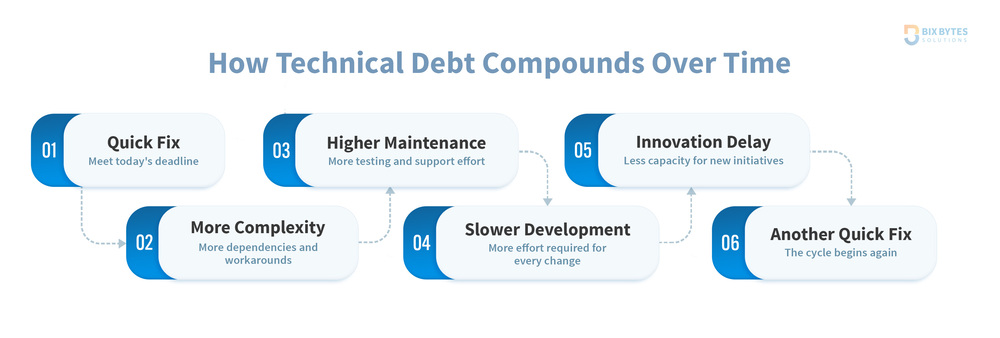
Eventually, an organization can reach a point where maintaining the existing technology consumes a growing share of engineering capacity.
The company isn't just paying to maintain old technology. It is paying for the opportunities that old technology makes harder to pursue.
How Does Technical Debt Affect a Business?
1. Technical Debt Increases Maintenance Costs
One of the most obvious effects of technical debt is increased maintenance cost.
Imagine that a business requests what appears to be a relatively small feature.
On a modern, well-structured system, the change may involve one or two components.
On a heavily indebted legacy system, developers may discover that the feature depends on several older applications, databases, APIs, and integrations.
Suddenly, the team needs to:
-
Understand legacy dependencies
-
Modify multiple components
-
Test unexpected interactions
-
Resolve compatibility issues
-
Perform additional regression testing
-
Document the changes
-
Coordinate deployments across dependent systems
The feature itself may be simple.
The complexity surrounding it isn't.
2. Technical Debt Creates Innovation Friction
Innovation depends on the ability to experiment, learn, and change quickly.
Technical debt can make all three more difficult.
A product team may want to introduce a new capability. Engineering then needs to ask:
-
What existing systems will this affect?
-
Can we safely modify those systems?
-
What dependencies could break?
-
How much regression testing is required?
-
Is the infrastructure capable of supporting it?
-
What technical work is required before launch?
What should have been a product decision becomes an architecture discussion.
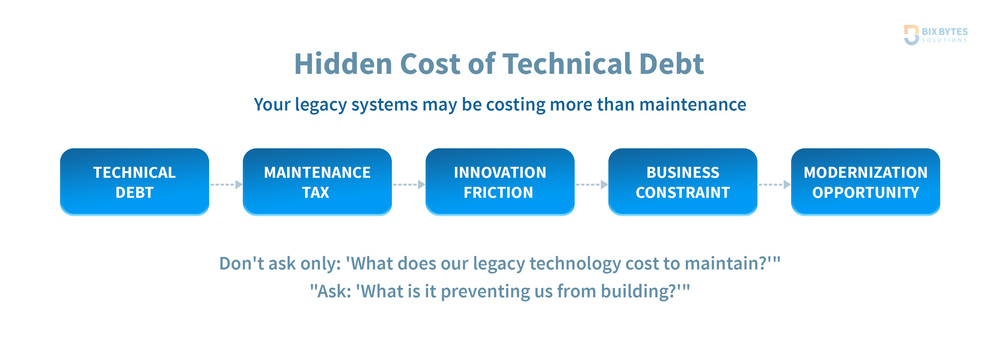
The question isn't only whether your technology works today. It's whether your technology allows the business to move tomorrow.
3. Technical Debt Reduces Developer Productivity
Technical debt creates what can be described as a maintenance tax on engineering teams.
Developers have limited time and attention.
That capacity can be invested in:
-
New features
-
Product improvements
-
Automation
-
Performance improvements
-
New capabilities
-
Customer-requested functionality
Or it can be consumed by:
-
Legacy code
-
Recurring bugs
-
Manual processes
-
Workarounds
-
Compatibility problems
-
Outdated dependencies
-
Difficult deployments
Technical debt does not necessarily mean developers are less capable or less productive.
It means more of their productive capacity is consumed by maintaining yesterday's decisions.
4. Legacy Systems Can Increase Business and Operational Risk
Technical debt isn't only about development speed.
Poorly maintained legacy systems can introduce operational and technology risks such as:
-
Unsupported software versions
-
Security vulnerabilities
-
Difficult-to-replace dependencies
-
Missing documentation
-
Single points of failure
-
Limited integration capabilities
-
Difficult disaster recovery
-
Manual operational processes
-
Dependence on individuals who understand critical systems
The cost of not knowing what might break can become a hidden form of technical and operational risk.
5. Technical Debt Can Affect Customer Experience
Customers don't see your architecture diagram.
They see the result.
Technical debt can indirectly contribute to:
-
Slow application performance
-
Reliability problems
-
Delayed feature releases
-
Integration limitations
-
Inconsistent digital experiences
-
Slower responses to customer requirements
A technical limitation can become a customer limitation.
What Are the Warning Signs of Technical Debt?
The answer is almost certainly yes if you're asking whether your business has technical debt.
The more important question is whether that debt is becoming a constraint.
“We can't change that because it might break something.”
This is one of the clearest warning signs.
Small changes consistently take too long
If relatively simple requirements consistently require significant engineering effort, investigate what is happening underneath the feature.
Developers rely heavily on workarounds
Workarounds can be useful. But when they become the normal way of working, they can indicate deeper architectural problems.
Nobody wants to touch certain parts of the system
If only one or two people understand a critical application, the organization may have both technical and operational risk.
The same bugs keep returning
Recurring problems can indicate that teams are repeatedly treating symptoms instead of addressing underlying technical causes.
New systems continually have to work around old systems
If every new capability requires another workaround around an existing platform, technical debt may be limiting the organization's ability to evolve.
How Should Businesses Prioritize Technical Debt?
One of the most common mistakes organizations make is trying to fix everything at once.
That rarely works.
Technical debt should be prioritized according to business impact, not simply the age or technical quality of the code.
|
Factor |
Key Question |
|
Business Impact |
What business process or strategic initiative does this affect? |
|
Risk |
What happens if we don't address it? |
|
Cost |
How much effort does the current problem consume? |
|
Future Impact |
Will this become more expensive or restrictive as the business scales? |
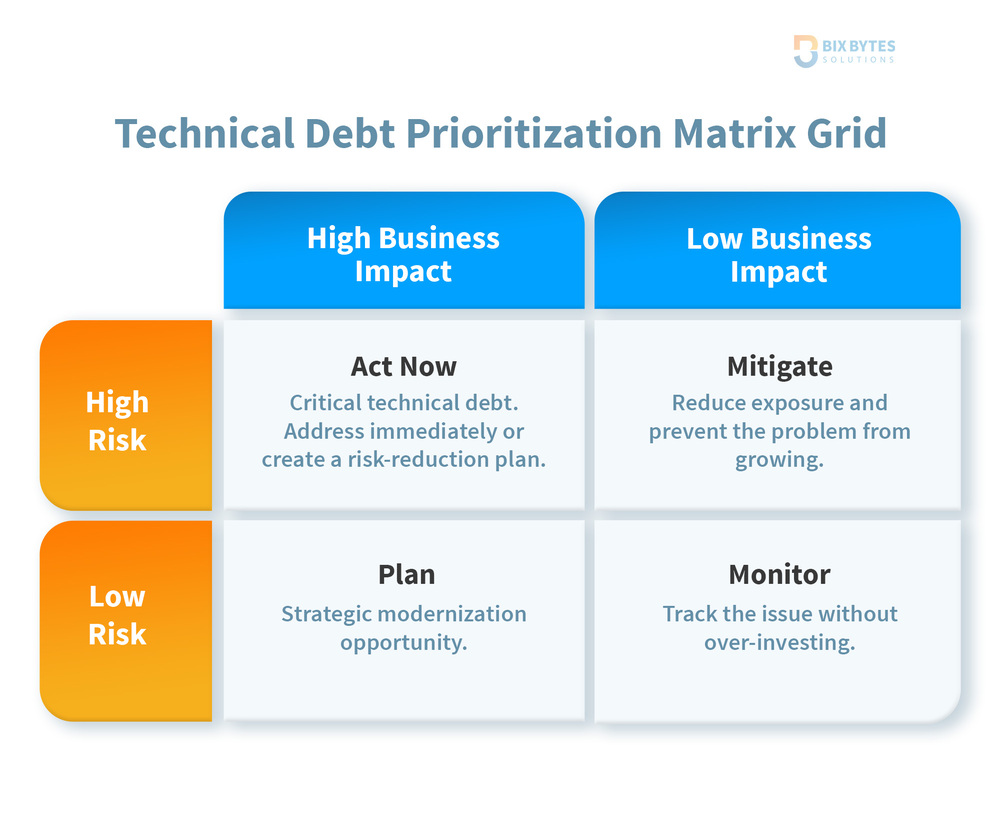
The oldest technical debt isn't necessarily the most important technical debt.
The priority should be the debt that creates the greatest combination of business friction, risk, cost, and future constraint.
Technical Debt vs. Modernization: What Should You Do?
There is no universal answer.
The right strategy depends on the condition of the system, its business value, its risk profile, and the organization's future requirements.
A full rewrite may be appropriate in some cases. In others, it can introduce unnecessary cost and risk.
-
Strategy 01: Refactor
- Refactors existing code without fundamentally changing what the system does.
-
Best when: The architecture is fundamentally sound, the application still meets business requirements, and code quality has degraded.
-
Strategy 02: Modernize
-
Updates technology, architecture, infrastructure, or development practices while retaining valuable parts of the existing system.
-
Best when: The system still provides business value, technology is becoming difficult to maintain, and the architecture needs to evolve.
-
-
Strategy 03: Replace
-
Moves away from an existing system toward a different platform or architecture.
-
Best when: The current system no longer meets business needs, maintenance costs are excessive, and the technology is difficult to support.
-
-
Strategy 04: Retire
-
Removes a system entirely. If an application no longer provides meaningful business value, continuing to maintain it simply creates unnecessary cost and risk.
-
Not every legacy system needs to be modernized. Some need to be retired.
A Practical Technical Debt Assessment Framework
Before deciding what to fix, organizations need a clear picture of their technology landscape.
-
1. Map the Technology Landscape
-
Identify applications, databases, APIs, infrastructure, third-party dependencies, integrations, and critical business processes.
-
-
2. Identify Technical Pain Points
-
Look for recurring incidents, slow development cycles, manual processes, performance problems, unsupported technologies, security concerns, integration limitations, and difficult deployments.
-
-
3. Connect Technical Problems to Business Impact
-
Don't stop at “this code is difficult to maintain.” Ask what that difficulty costs the business. Example: Difficult legacy integration additional development effort delayed feature release delayed customer value.
-
-
4. Prioritize the Highest-Value Problems
-
Consider business impact, risk, current cost, strategic importance, and future growth.
-
-
5. Build a Remediation Roadmap
-
Define what needs to change, why it matters, dependencies, effort, risk, timing, and measurable success criteria.
-
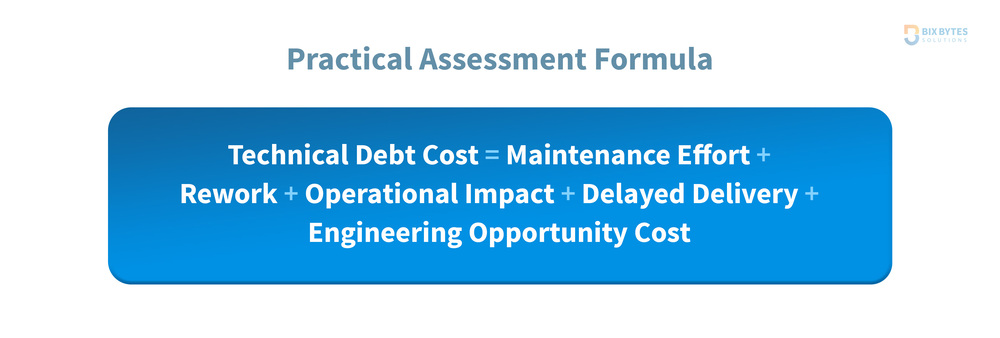
How Can Technical Debt Cost Be Assessed?
How Can Technical Debt Be Reduced Without Disrupting the Business?
Reducing technical debt does not necessarily require a “big bang” transformation.
In many organizations, incremental progress is safer and more practical.
A business can begin by:
-
Identifying the systems creating the most friction.
-
Quantifying their business impact.
-
Addressing high-risk dependencies.
-
Improving automated testing and deployment processes.
-
Modernizing high-value components incrementally.
-
Removing obsolete applications and dependencies.
-
Building technical debt review into ongoing technology planning.
The goal isn't to achieve a theoretically perfect architecture.
The goal is to create a technology environment that is easier to change, operate, scale, and align with business priorities.
How Bix Bytes Solutions Can Help With Technical Debt and Modernization
Technical debt becomes difficult to address when organizations look at isolated technical problems without understanding the larger system.
At Bix Bytes Solutions, the focus is not simply on asking:
“What needs to be fixed?”
The more important questions are:
-
Why does it need to be fixed?
-
What business problem is it creating?
-
What happens if we don't fix it?
-
What should the technology landscape look like as the business grows?
This business-first approach can help organizations evaluate their existing technology environment, identify modernization opportunities, prioritize technical debt, and develop a practical technology roadmap.
The objective isn't to replace technology simply because it is old.
The objective is to make technology easier to change, scale, maintain, and align with business growth.
Is Technical Debt Slowing Your Business Down?
If your team is spending too much time maintaining legacy systems, working around technical limitations, or delaying product initiatives because existing technology is difficult to change, it may be time to assess your technical debt.
Bix Bytes Solutions can help you identify where technical debt is creating business friction and determine which issues should be refactored, modernized, replaced, or retired.
Understand:
-
Where your biggest technical constraints are
-
Which systems create the greatest business risk
-
Where maintenance effort is consuming engineering capacity
-
Which modernization opportunities should be prioritized
-
What a practical remediation roadmap could look like
Request Your Technical Debt Assessment
No need to start with a full system replacement. Start by understanding what is holding your technology and your business back.
Frequently Asked Questions About Technical Debt
Is technical debt bad?
No, technical debt is not necessarily bad. It can be a deliberate trade-off that allows a business to launch faster, meet a deadline, or test an idea. It becomes problematic when it is unmanaged and begins increasing development costs, operational risk, complexity, or barriers to innovation.
What is an example of technical debt?
A temporary software workaround that becomes permanent is a common example of technical debt. A development team may implement a quick integration to meet a launch deadline. If that workaround remains for years and makes future changes more difficult, the resulting complexity becomes technical debt.
How does technical debt affect a business?
Technical debt can increase maintenance costs, slow software development, reduce engineering capacity for innovation, increase operational risk, and make it harder to respond to changing customer requirements.
How do you reduce technical debt?
Technical debt can be reduced by identifying the highest-impact problems, connecting them to business outcomes, prioritizing remediation, and implementing a phased technical debt management or modernization roadmap.
Should a company completely rewrite a legacy system?
No, a complete rewrite is not always the best solution for a legacy system. Depending on business requirements and technical conditions, refactoring, incremental modernization, replacement, or retirement may provide a better balance of cost, risk, and business value.
How often should technical debt be reviewed?
Technical debt should be reviewed continuously as part of technology and product planning. Regular reviews help organizations identify growing maintenance costs, emerging risks, and architectural constraints before they become major barriers to business growth.
What is the difference between technical debt and legacy systems?
Technical debt and legacy systems are related but different concepts. A legacy system is typically an older technology system that remains in use, while technical debt describes the future cost and complexity resulting from technical decisions. A legacy system may contain significant technical debt, but not every legacy system has the same level of debt.
When should a company consider software modernization?
A company should consider software modernization when existing technology creates significant maintenance costs, operational risk, scalability limitations, integration challenges, or barriers to strategic business initiatives. The decision should be based on business impact and future requirements rather than technology age alone.
About the Author

Bix Bytes Solutions
About Bix Bytes Solutions
Bix Bytes Solutions is a technology engineering and consulting company with expertise in custom software development, cloud engineering, application modernization, and technology consulting. Our engineering teams work with businesses on the challenges that come with building, maintaining, and scaling software systems. This article reflects our practical perspective on managing technical debt and building technology that can evolve with business needs.
Sources & Further Reading
-
Martin Fowler — Technical Debt Quadrant: Conceptual reference for deliberate and inadvertent technical debt. Technical Debt Quadrant
-
ACM Digital Library — Research literature covering software engineering, software maintenance, technical debt, and related engineering practices. ACM Digital Library
-
IEEE Xplore — Research and publications covering software engineering, architecture, maintenance, and technical debt. IEEE Xplore
-
NIST — Authoritative cybersecurity and technology guidance. National Institute of Standards and Technology
-
CISA — Cybersecurity guidance and vulnerability-management resources. Cybersecurity and Infrastructure Security Agency
Final Takeaway: Technical Debt Is a Business Decision
Technical debt is easy to ignore when the system still works.
But “still working” isn't the same as still serving the business well.
When legacy systems make features slower to build, integrations harder to deliver, incidents harder to resolve, and modernization more expensive, technical debt becomes a strategic issue.
The goal isn't to eliminate every piece of technical debt.
The goal is to understand it.
Measure it. Prioritize it. Manage it. And reduce the debt that is preventing your business from moving forward.
Because the most expensive technical debt may not be the code that costs the most to maintain.
It may be the technology constraint that prevents your business from building what comes next.
Is your technology becoming a growth constraint?
Start with an assessment. Understand where technical debt is creating business friction before deciding what needs to change.
Request a Technical Debt Assessment


GET IN TOUCH


SWITZERLAND
Bix Bytes Solutions Pvt. Ltd.
Zunstrasse 11
8152 Opfikon
Switzerland

INDIA - Mangalore
Bix Bytes Solutions Pvt. Ltd.
3-1-46, Bejai Main Rd
Mallikatte, Bejai
Mangaluru -575004
Karnataka, India.

CANADA
Bix Bytes Solutions
315 St Germain
Ave Toronto ON M5M 1W4 Toronto Ontario
Canada
INDIA - Bangalore
Bix Bytes Solutions Pvt. Ltd.
Brigade Rubix, 20, Unit No. 204, 2nd floor,
HMT Watch Factory Main Road,
Phase 1, Peenya, Bangalore 560 022
Karnataka, India.
Copyright © 2026 BixBytes Solutions